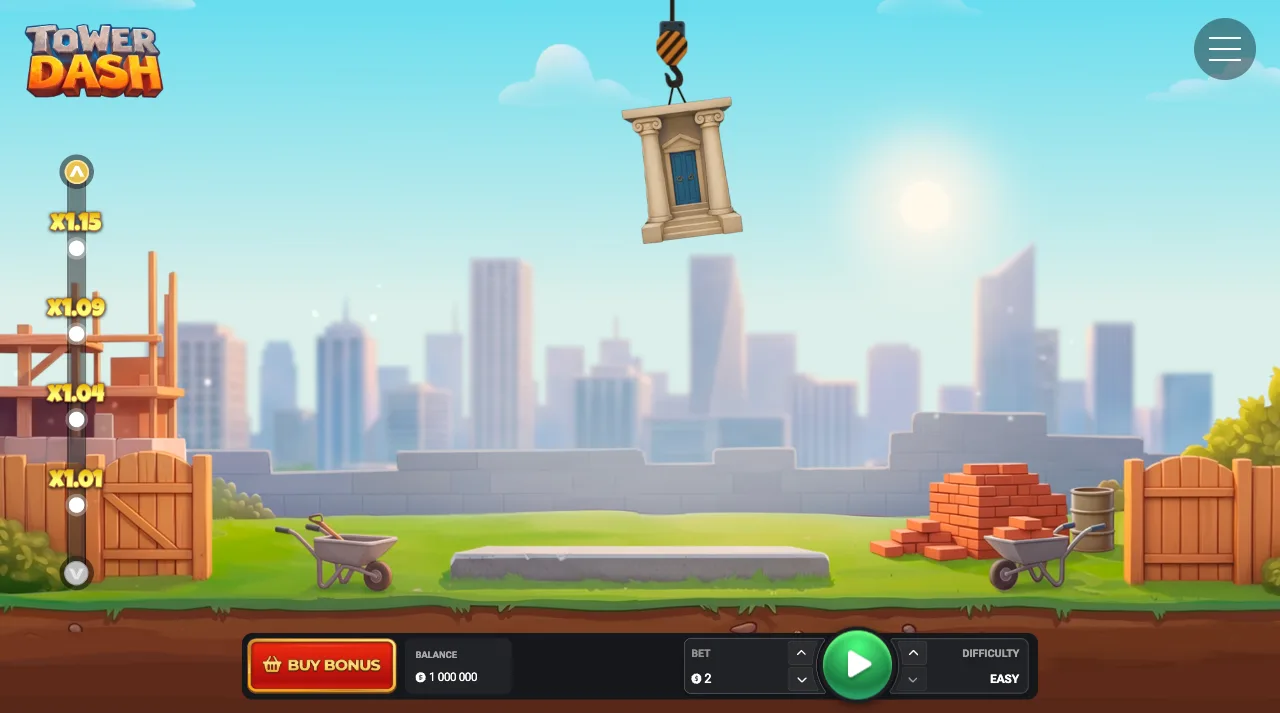
What a good round looks like
A good round is uneventful for the first four crates. Keep the stake small, leave the difficulty alone and watch one full pass of the crane before the opening tap, so you know where the swing turns.
On blocks one to four, concentrate on placement. The ladder moves slowly there: in the demo client an Easy round read x1.01, x1.04, x1.09 and x1.15 over those four.
From block five the steps get wider. Each extra crate adds more than the one below it, and each one is another drop that can fall. A few demo rounds show this in a couple of minutes, and after that you can play a round of Tower Dash on your phone.
The two things that end a tower
A round ends with a fallen block or a press of Cash Out.
The first is a mistimed release. You tap at the end of the swing instead of the middle, the block falls, and the round is over. Practice in the demo reduces these mistakes.
The second is your own Cash Out, which is the ending that pays. It is available after each block that lands and banks the multiplier on screen.
The difficulty also sets a maximum height: 40 blocks on Easy, 38 on Medium and 35 on Hard. The rules screen does not describe what happens when a tower reaches it. A planned exit height is what keeps a round from ending on a fallen block.
Difficulty, in practice
You set the difficulty before each round, so you can change it between towers.
| Setting | Maximum height | Note |
|---|---|---|
| Easy | 40 blocks | The observed demo ladder on this page was read here |
| Medium | 38 blocks | The mode both bonus buys use |
| Hard | 35 blocks | The lowest of the three height limits |
The provider publishes one return to player figure, 96% in the client build. The difficulty changes the maximum height, the chance of placing a block and the potential payout, and the provider publishes no figures for the last two.
Reading the ladder
Watch how the ladder moves over the first blocks of a tower. In the demo client an Easy round stood at x1.09 after three blocks, so cashing out that early returns little more than the stake.
Once the steps widen, the multiplier you hold is worth more, and every further crate puts that whole amount at risk.
A useful habit is a fixed exit height decided before the round starts, with at most one deliberate override per session. Cash Out is manual, so the game will not enforce that decision for you.
Test the number in the demo first, then open Tower Dash on your phone and keep to it.